.png?width=624&height=405&name=Your%20paragraph%20text%20(16).png)
(And why it has very little to do with performance)
There’s an uncomfortable truth in the hedge fund industry that rarely gets stated outright. Most funds that struggle to raise capital don’t fail because their strategy is flawed or their performance is weak. They fail because they never meaningfully enter the allocator’s mind in the first place.
This is not a performance problem. It’s a visibility and memorability problem.
To understand why, it helps to look at the process from the allocator’s perspective rather than the manager’s.
An institutional allocator might review dozens of funds over the course of a few weeks. Each one arrives with a polished pitchbook, a detailed factsheet, and a carefully constructed narrative around differentiation. On paper, many of these funds are credible. Some are even exceptional.
But very few are remembered.
The real funnel is not what you think
What most managers imagine is a fairly rational process: funds are reviewed, the strongest performers rise to the top, and capital is allocated accordingly. In reality, there is a much earlier filter that determines whether a fund even gets seriously considered.
The critical drop-off doesn’t happen at the due diligence stage. It happens much earlier, between “reviewed” and “remembered.” If a fund does not make it past that point, its performance—no matter how strong—is effectively irrelevant.
This is where most fundraising efforts quietly break down. 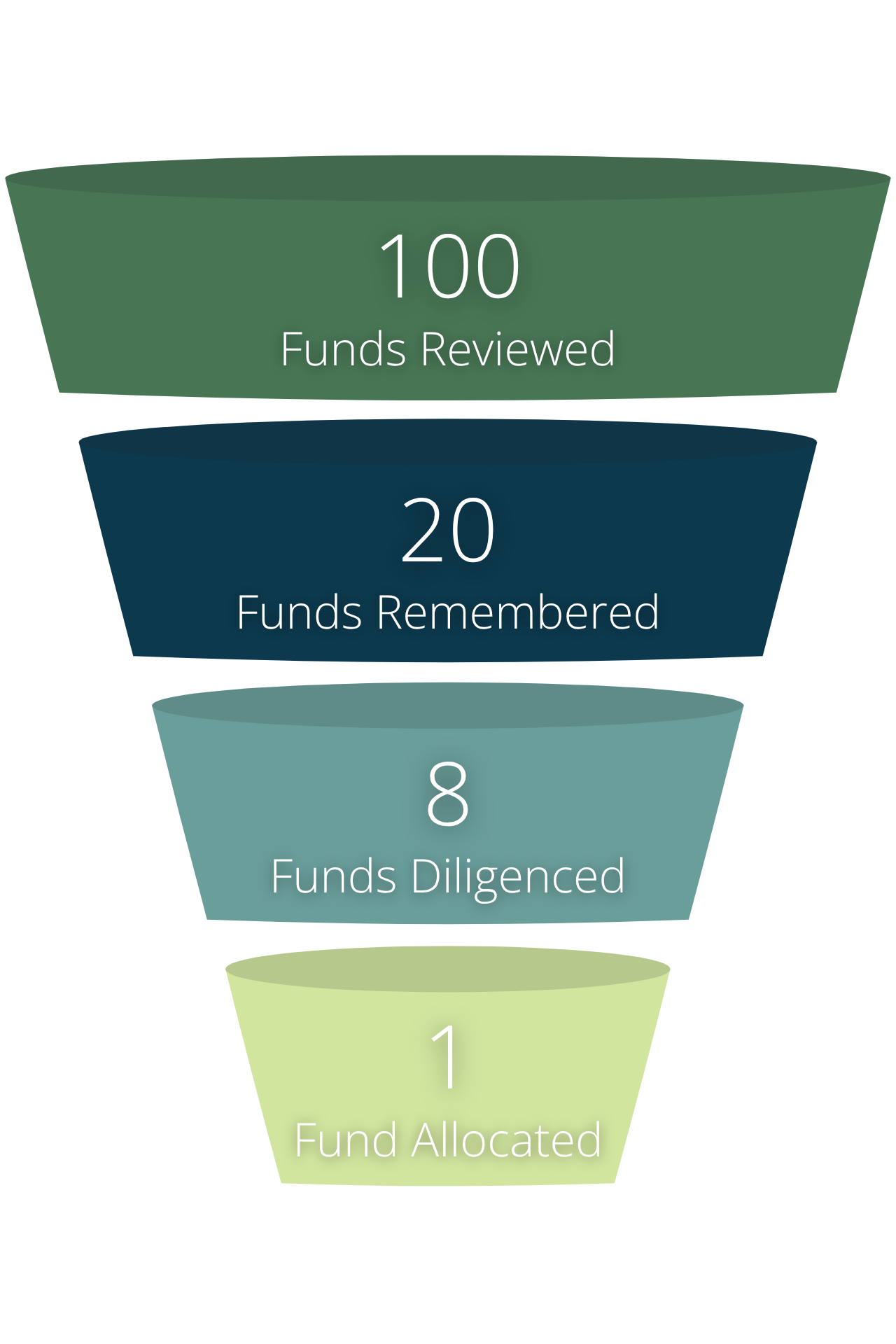
Attention comes before evaluation
The industry tends to operate under the assumption that capital flows to the best ideas. Higher Sharpe ratios, better drawdown control, and more robust processes are all treated as the primary drivers of allocation decisions.
But in practice, those factors are only evaluated after a fund has earned enough attention to justify deeper analysis. And attention, in a world where allocators are constantly inundated with information, is extremely limited.
Allocators are not carefully reading every document they receive. They are scanning, filtering, and prioritizing. They are making rapid judgments about what deserves their time and what does not. If your message is not immediately clear, it is unlikely to be revisited later.
Clarity, therefore, is not a “nice to have.” It is the entry ticket.
Why more information often backfires
Faced with this reality, many managers instinctively respond by adding more detail. They expand their decks, increase the number of slides, and try to anticipate every possible question an allocator might have. The intention is to build credibility through thoroughness.
The effect is often the opposite.
From the allocator’s point of view, dense and overly technical materials introduce friction. They require time and effort to process, and that effort is weighed—consciously or not—against dozens of other opportunities competing for attention. When something feels unnecessarily complex, it creates a subtle but powerful signal: this will take work.
And in most cases, work gets deferred.
Your factsheet illustrates this dynamic particularly well. It is usually the first document an allocator reviews, and it is often where initial impressions are formed. If it is not clear, consistent, and easy to digest, the allocator is forced to slow down and interpret, which is exactly what they are trying to avoid.
Friction is the silent deal killer
Before an allocator evaluates your returns or your investment process, they are making a much simpler judgment: how easy is it to engage with this manager?
This question is rarely stated explicitly, but it influences behavior at every stage. If your materials are intuitive, well-structured, and quick to navigate, the process feels efficient. If they are disorganized or overly dense, the process feels burdensome.
That perception compounds over time.
What’s important to recognize is that this extends beyond any single document. The organization of your materials, the ease of accessing information, and the overall flow of your content all contribute to the allocator’s experience.
A well-structured environment—whether in a pitchbook or a data room—signals professionalism and discipline. It tells the allocator that working with you will be straightforward and efficient, which meaningfully improves the quality of the due diligence experience.
The paradox of sophistication
There is a natural tendency in this industry to equate complexity with sophistication. Many strategies are, in fact, complex, and it can feel necessary to communicate that complexity in order to demonstrate expertise.
But sophistication in communication works differently.
The most effective managers are not the ones who present the most information. They are the ones who make their strategy feel understandable without oversimplifying it. They reduce the cognitive burden on the allocator while still conveying depth.
In other words, they do not just have a strong strategy. They make that strategy easy to grasp.
What actually differentiates you
By the time an allocator reaches a serious evaluation stage, most funds in consideration are already credible. The differentiating factor is rarely raw performance alone. It is the combination of clarity, ease of engagement, and overall experience.
Funds that consistently raise capital tend to share a few common traits. They can be explained in a single, clear sentence. Their materials are structured in a way that guides the reader logically. And interacting with them—whether through documents or conversations—feels efficient rather than demanding.
These qualities are not cosmetic. They directly influence whether a fund progresses through the funnel.
A simple test
A useful way to evaluate your own positioning is to step outside of it briefly and look at your materials as an allocator would.
After reviewing them, ask yourself a few basic questions:
- Can the strategy be understood quickly without additional explanation?
- Would anything about it stand out after reviewing multiple similar funds?
- Does the experience feel smooth, or does it require effort to piece together?
If the answers are not immediately clear, the issue is unlikely to be performance.
It is far more likely to be attention.
Closing thought
At its core, capital allocation is not just a rational process driven by numbers. It is also a human process shaped by time constraints, cognitive limits, and perception.
And in that process, the first hurdle is not outperforming your peers.
It is being remembered by them.
The views expressed above are not necessarily the views of Thalēs Trading Solutions or any of its affiliates (collectively, “Thalēs”). The information presented above is only for informational and educational purposes and is not an offer to sell or the solicitation of an offer to buy any securities or other instruments. Additionally, the above information is not intended to provide, and should not be relied upon for investment, accounting, legal or tax advice. Thalēs makes no representations, express or implied, regarding the accuracy or completeness of this information, and the reader accepts all risks in relying on the above information for any purpose whatsoever.