
Four things hedge fund managers should do before year-end to prepare for a more productive 2027.
By late November, investor calendars are filling up, holiday schedules are taking shape, and year-end reporting is beginning to compete for everyone's attention. For hedge fund managers raising capital, December can start to feel like a month when very little gets done.
But a quieter fundraising calendar doesn't have to mean a quieter marketing calendar.
In fact, the final weeks of the year offer an opportunity to address the things that tend to get pushed aside when everyone is busy scheduling meetings, responding to diligence requests, and chasing prospective investors.
Here are four areas worth revisiting before the calendar turns to January.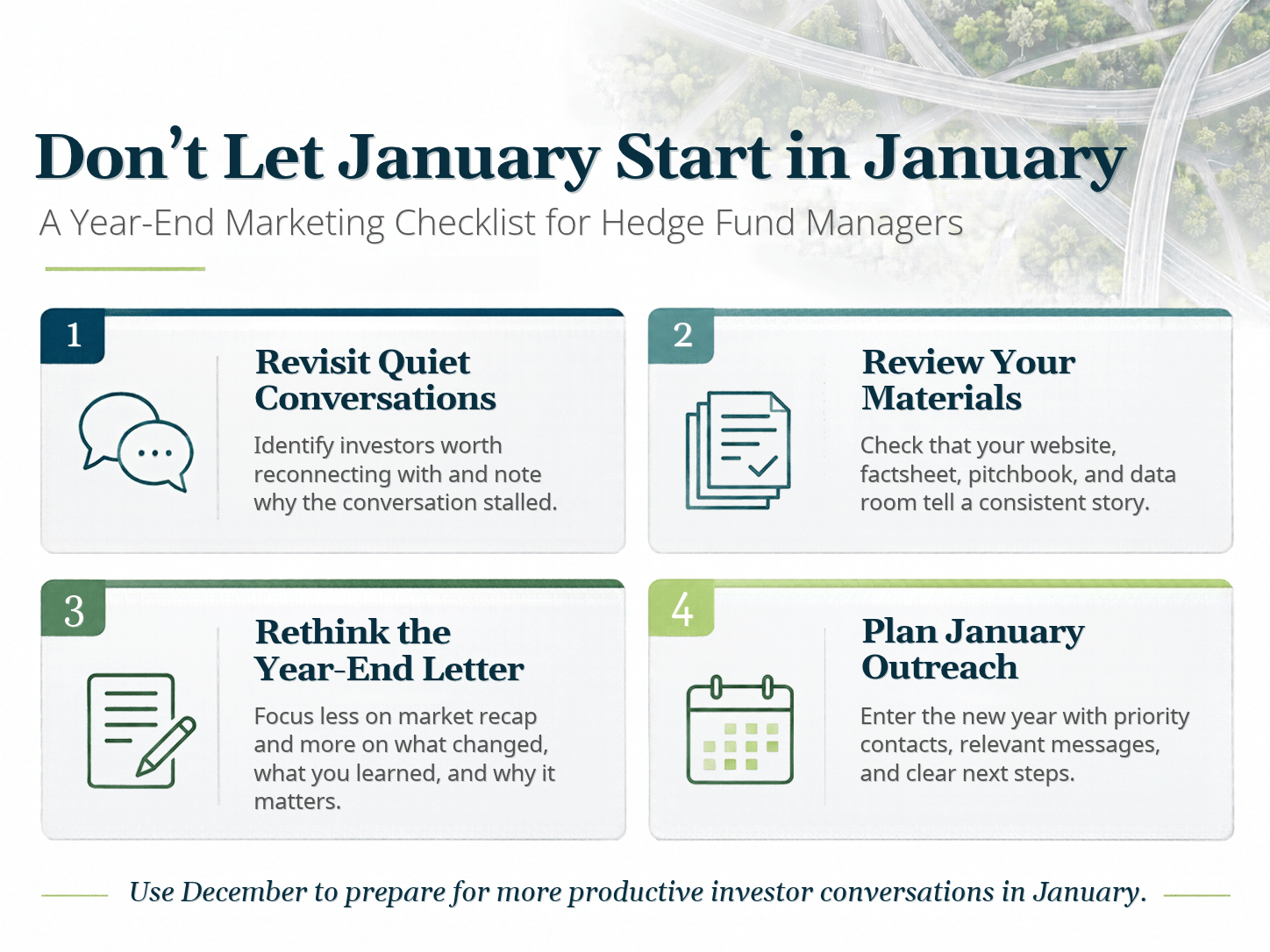
1. Revisit the Conversations That Went Quiet
Think back to the investors you spoke with over the past year. Some expressed interest but weren't ready to allocate. Others requested additional information, mentioned an upcoming portfolio review, or suggested reconnecting after year-end.
What happened to those conversations?
An investor who wasn't ready in April may have a different set of priorities today. But that doesn't mean a generic "just checking in" email will get their attention.
Review your CRM and identify the conversations that deserve another look. Pay particular attention to the reasons investors deferred, the questions they raised, and any timelines they mentioned.
Marketing Alpha
Create a short list of investors to reconnect with in January. For each, record the last meaningful interaction, the reason the conversation stalled, and a specific reason to reach out again..
A relevant follow-up is far more useful than a blanket New Year's greeting
2. Give Your Marketing Materials a Year-End Review
When was the last time you looked at your pitchbook or website from the perspective of someone encountering your firm for the first time?
Over the course of a year, marketing materials have a way of drifting out of sync. Your factsheet gets updated monthly, but your pitchbook still references an older AUM figure. Your website describes a strategy you've since refined. Your data room contains multiple versions of the same document.
Individually, these may seem like minor issues. Collectively, they can create unnecessary questions during an investor's due diligence process.
December is a good time to review your materials for consistency, accuracy, and relevance. Beyond the numbers, consider whether your messaging still reflects how you actually manage money today.
Marketing Alpha
Open your website, latest factsheet, pitchbook, and investor data room side by side. Compare your strategy description, investment terms, AUM, team information, and risk disclosures.Flag anything inconsistent or outdated and establish a process to keep these materials aligned throughout 2027.
3. Rethink Your Year-End Investor Letter
Every December, investors receive a flood of year-end letters. Market recaps, performance summaries, economic outlooks, and predictions for the coming year begin competing for attention.
The question is whether yours gives the reader a reason to keep reading.
A year-end letter shouldn't simply be twelve monthly letters stitched together. Nor does it need to offer another broad assessment of interest rates, inflation, or geopolitical risks that investors have already read elsewhere.
This is an opportunity to explain what happened within your strategy, what you learned, and what investors should understand about how you're approaching the year ahead.
Consider the questions an investor evaluating your fund might actually ask. What worked as expected? What didn't? Did your portfolio behave differently under certain market conditions? Has anything changed in your investment process, risk management, or opportunity set?
You don't need to answer every question, but you should give readers something more useful than a recap of the headlines.
And remember that your letter may reach prospective investors who aren't familiar with your strategy. Make sure the discussion provides enough context to be understood without requiring someone to dig through your previous correspondence.
Marketing Alpha
Before sending your year-end letter, ask someone outside your investment team to read it. Can they identify your most important takeaways? Does the letter explain what those developments mean for your strategy?If the answer is no, consider shortening the market commentary and giving more space to the decisions, observations, and lessons specific to your fund.
4. Plan Your January Outreach Before the Holidays
January has a way of arriving faster than expected. Between updating performance, preparing investor reports, and catching up after the holidays, the first few weeks can disappear before a manager has given much thought to business development.
Rather than starting the year by asking who you should contact, use December to identify the conversations you want to have.
That might include investors who requested a year-end update, prospects who previously expressed interest in your strategy, or contacts who indicated that their allocation priorities would become clearer in the new year.
Think about what you're going to say, too. Not everyone needs the same communication. Some contacts may warrant a personal note, while others would benefit from receiving your year-end letter or updated materials.
The objective isn't to fill every available slot on your January calendar. It's to approach the new year with a clear understanding of where your time is best spent.
Marketing Alpha
Build your first-quarter outreach plan before closing out December. Identify your priority contacts, the reason for reconnecting, the information you'll share, and the next step you'd like to achieve.
Where appropriate, schedule those follow-ups now rather than relying on your memory after the holidays.
A Better Start to the New Year
There's nothing wrong with slowing down over the holidays. Investors are doing it, and fund managers should have an opportunity to do the same.
But a little preparation in December can make a meaningful difference when normal schedules resume. Updated materials, a thoughtful year-end letter, and a well-organized investor pipeline can help you spend less time getting organized and more time having productive conversations.
The goal isn't to do more marketing before year-end. It's to make the marketing you're already doing more useful.
If you'd like to discuss your year-end communications or how to prepare your investor outreach strategy for 2027, get in touch with us.
The views expressed above are not necessarily the views of Thalēs Trading Solutions or any of its affiliates (collectively, “Thalēs”). The information presented above is only for informational and educational purposes and is not an offer to sell or the solicitation of an offer to buy any securities or other instruments. Additionally, the above information is not intended to provide, and should not be relied upon for investment, accounting, legal or tax advice. Thalēs makes no representations, express or implied, regarding the accuracy or completeness of this information, and the reader accepts all risks in relying on the above information for any purpose whatsoever.
Artificial intelligence tools were used to assist in the development and drafting of this article. The content is subject to human editorial review, and Thalēs retains responsibility for its final publication.